



'The 540 will not only improve upon the famed performance of our legendary 526, which it replaces,’ says Balance Catamarans founder and president Phil Berman, ‘but, based on our preliminary polars, she’ll be the fastest model we’ve ever built. Add to that there are significant improvements in her interior design and liveability, and a marked increase in volume and luxury throughout, and the 540 will be a dramatic evolution of our 526.’
It’s a punchy call from a shipyard that is moving on from its best-selling and fastest cruising cat, the 16m/52.5ft 526, and replacing her with the 16.6m/54.5ft 540. Rather than simply stretching the 526 and renaming it, Balance takes a different approach. For the 540, the yard redesigned the yacht from stem to stern, requiring significant investment in new tooling.
It’s a continuation of a process that has seen Balance redesign and extend its model range. The 442 became the 464, the first of which will launch this year. And the 482 became the 502, which is already in the water and drawing strong attention. The flagship 750 is now in final sea trials, while the Balance 580 was added to the model range in 2025 with a handful of catamarans already launched and many more in build and on order.
‘The plan to phase out the 526 kicked off a long debate and a bittersweet one at that,’ notes Dean Paarman, director of South African operations. 'The 526 is an award-winning model that drew both the industry’s praise and that of its owners who are sailing the world. So, yes, the newly designed Balance 540 indeed has big shoes to fill,’ he continues.
The Balance 526 has won some hefty races. Norhi won the Cape2Rio race in 2023, and in the 2025 ARC Europe Bermuda-to-Faial leg, the 526 Catalyst came in a day and a half ahead of the next boat. So, the obvious question is: why would you end that amazing run?
‘We felt we could dramatically improve on the 526 with a host of innovations and new design initiatives,’ explains Paarman. ‘To be clear, most industry builders upgrade their models every five-to-six years so the 12-year run of the Balance 526 is testament to the original design and innovation brought about by its naval architect Anton du Toit, co-designer Phil Berman and production chief and guru Jonathan Paarman.
There were several factors that were considered when the new design was in its early mockup stage. Additional volume to her hulls was needed to accommodate the extra Lithium-Ion battery capacity needed to run all the mod cons required on a modern blue-water boat as well as the addition of Integrel Solutions’ 48V E-Power alternators to her 57hp Yanmar engines, which outputs 14-15kW and thereby removes the need for a generator. Balance also offers the 540 with Integrel’s Hybrid E-drive system, which produces up to 20kW per engine of charge when operating under diesel.
Adding this payload required the designers to widen her gradually from the midships aft. But that allowed the interior design team to add larger aft cabins and an entire new owner’s suite aft on the starboard side.
The opportunity to create a true fourcabin option was a big plus too. The 526 was fundamentally a three-cabin boat, Dean Paarman explains. ‘While we built a few four-cabin 526s that the owners enjoy today, we knew we could design the 540 as a robust four-cabin boat, with a truly luxurious owner’s suite.’
With these changes and the commitment to have a true four-cabin 540 option, the design team added waterline length and widened the hulls a bit which in turn also gave more underwing clearance. They lengthened the main saloon considerably as well. ‘From here we rolled up our sleeves and got to work,’ adds Dean Paarman.
The biggest innovations in sailing and the marine industry today have to do with energy. A leading player here is the UK-based Integrel with its new E-Drive, a combined power generation and hybrid propulsion unit. Balance has partnered with Integrel since its earliest days and its catamarans are the first to launch with this dynamic new energy-saving system globally.
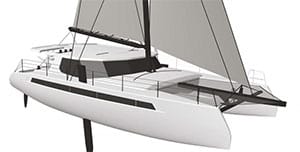
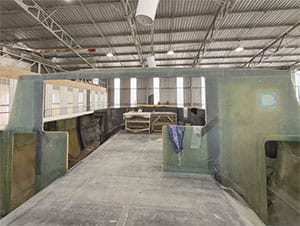
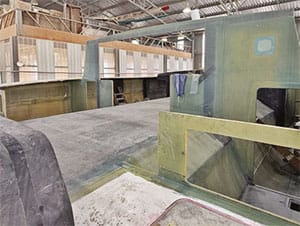
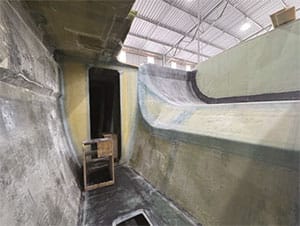
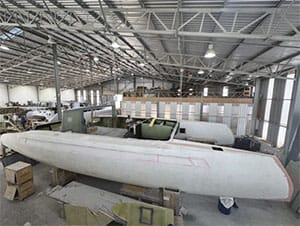
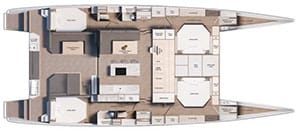
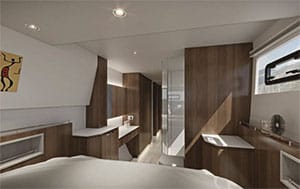
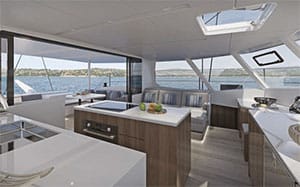
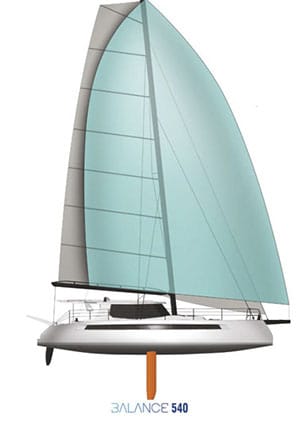
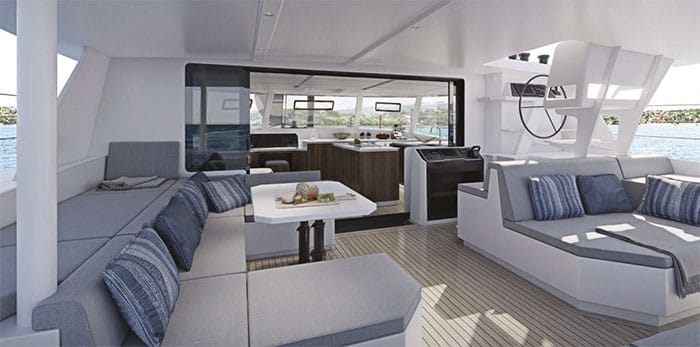
1. The 540 has a cutter rig. The high aspect daggerboards ensure good upwind VMG. 2-5. Balance 540 in build. A carbon fibre skeleton with structural bulkheads and floors is laminated into the foam cored e-glass hulls. 6. An advantage of the Balance 540 over the old 526 is having enough extra internal volume for spacious four-cabin accommodation, including a skipper’s quarters. 7. There are four options for the four-cabin boat, one of those four could also be an office and a convertible bedroom which can turn into a full king when the desk is folded away. 8. Reconfigured bridge deck layout. Having the galley island unit running fore-and-aft instead of athwartship creates an easier flow between the aft cockpit and saloon. 9. Permanently rigged cutter headsails and Code 0 for easy gear changes of sail power.
‘We have been testing and partnering with Integrel on the new E-Drive hybrids,’ says Roger Paarman, Balance’s general manager in the St Francis yard, where the 540, 580 and 750 are built. ‘We have been blown away at what insanely fast charging this new system achieves. You’re getting up to 20kW per engine. Your battery can be nearly flat and you pump it up in less than an hour with this system.’
When you are talking to anyone at Balance Catamarans, they will talk about innovation as their defining ethos. So, they went all-in when envisioning the evolution of the 526 from the smallest detail to sweeping changes. ‘We had this great opportunity to look at our premier sailing vessel and make it better, from the smallest details to the most dramatic,’ explains Dean Paarman.
The design team benefitted from the already redesigned 464 and 502, drawing inspiration and innovative ideas from across all models from the smallest to the largest vessels. ‘She needs to go fast, she needs to sail really well in light air and she needs to be easy to sail shorthanded, comfortably by a couple. And she must be truly livable for a voyaging couple or family,’ explains Dean Paarman.
When it came to redesigning the 540’s hulls, Jonathan Paarman, chief of production, took the lead. (A bit of background here: there are three Paarmans at Balance. Roger, Dean, and Dean’s uncle, Jonathan, who was a renowned pro surfer in his youth and helped with the production of Hobie Cats the year South Africa hosted the World Championships in 1979, an event attended by 72 nations. That was the year Phil Berman, Balance Catamarans’ founder, represented the United States and won the World Championships. And the rest as they say is history).
‘Jonathan’s expertise is looking at these things almost like it’s a really big surfboard,’ explains Dean. ‘You can almost hear him think: “OK, if I want to make this thing go fast, where am I going to make these slight changes in the overall hull profile?” From there Jonathan and the rest of the design team took off.’
Working with Balance’s longtime naval architect Du Toit and Berman, the team made both large and incremental changes, aimed at adding both speed and luxury. For inspiration, they envisaged what a yacht might look like if they blended the 526 with the 580. As a result, the 540 is bigger than the 526 with considerably more interior volume and payload capacity. For instance, the size of the 540’s rig is a hybrid of the 580 and 526. Berman hangs his hat on his conviction that she’ll be faster than the 526 even as she features the interior comfort and added payload capacity of the larger 580.
‘What we want is a high-performance boat that is light, quick off the mark, but also has the ability to really power up, driving above 20kts and feeling like you’re completely in control’ explains Jonathan Paarman. Because she’s larger and carries more hull volume, the 540 has a taller rig and a longer carbon longeron than the 526, which allows her to carry a cutter rig with a self-tacking jib, a genoa sheeted on coachroof tracks, and a code sail flying off the bowsprit. ‘We tested this out on the first two 580s and it worked very well. There was no reason not to bring that innovation into the 540,’ explains Roger Paarman.
‘The cutter rig means the headsail line-up is more of a permanent fixture. It allows you to go up and down through your headsails much easier and much faster. You’re not having to bring down a Code Zero to put up a genoa, for instance, because you’ve got access to all of them,’ adds Roger Paarman.
‘Most of these boats are getting electric furlers so it’s just a matter of pushing some buttons. A key feature of Balance is that we always try to make our boats, no matter how big they are, easy to sail shorthanded. The cutter rig is an extension of that idea,’ explains Dean Paarman.
Balance has also coined its own term for adaptability: Versa. There’s a VersaHelm, which is a 90-degree canting wheel that can be swiveled into place both for the top and lower cockpit. A key factor here is that the VersaHelm is not just the ability to swing the helm in inclement weather, but the 360-degree view afforded by all Balance Catamaran designs in both the up and down positions, which Berman says makes this helm distinct in the industry. The Versa theme continues with the ingenious VersaStern that addresses the issue of what to do with heavy washboards. These simply slide inboard into a pocket forward of the aft beam.
The interiors borrow from the thinking on the 580. The 526 had an aft-facing athwartships galley to port, which limited the extent to which the aft bulkhead could open up, as Roger Paarman outlines. ‘I think the 540 layout is a very big change. By having the galley run fore-and-aft, the cockpit and the saloon flow into each other more widely, a nice flow through the boat, whereas if you end up putting a galley athwartships you have two spaces. Now, with the island unit, you can walk from the cockpit straight through the kitchen to the saloon. It flows better.’
Accommodation was a key factor driving elements of the 540 design and as a result there are a surprising number of variations offered.
‘There are actually six layouts now,’ adds Roger Paarman. ‘There are four options for the four-cabin boat, one of those four could also be an office and a convertible bedroom, like we feature on the 580 and all Balance models. It’s a three-quarter bed and an office but you can turn that bed into a full king if you fold the desk away and slide the bed out. On the other four-cabin there’s a few other options for a skipper’s cabin, we’ve also got two options of a three cabin.’
Those six variations are all offered with the standard base price. Both Roger Paarman and Phil Berman are convinced that the four-cabin option will be the most popular because it allows for more guests and/or private crew quarters.
Another aspect addressed is ventilation. All the forward-facing saloon windows have portlights and there’s a huge hatch in the coachroof for natural light and scooping in fresh air. The forward cabins will also benefit from an ingenious piece of design, a “VersaCool” if you like.
‘You’ve got deck hatches on the front and the bulkhead separating those from the cabins has a portlight,’ explains Roger Paarman. ‘You open that portlight and the hatch becomes sort of a brow so you can leave them open and they scoop air. Those big hatches have a drain at the bottom so even if it’s still raining you can still get really good air. Because it’s a portlight you can seal it up and it’s watertight if you are taking big waves over the front.’
This smart design feature was added to the new 502 that is making her North American debut at the Miami Boat Show and Annapolis Boat shows. ‘The 502 sailed to the Caribbean and she’s been doing a few of our Try-Before-You-Buy charters for a couple of weeks now,’ says Dean Paarman. ‘No one on board has needed to run their aircon because they’ve had great airflow in those forward berths. Those window ventilation ports are doing exactly what we hoped they’d do.’
In terms of construction, like the 502, the 540 will have a full carbon fibre skeleton with structural bulkheads and floors, which is then laminated into the Corecell foam-cored, glassfibre and epoxy hulls and deck. This carbon skeleton keeps weight down and gives the structure enormous strength and stiffness.
There is a Carbon XP option, which is full-carbon construction, but Balance does caution buyers that carbon hulls are a bit noisy at sea. As for the appendages, ‘We build the daggerboards in house,’ says Roger Paarman. ‘The carbon rudders with carbon stocks, carbon longeron and front beam are built in Cape Town by Fused Composite Design.’
Potential owners will most likely have a background in cruising cats and an understanding of how and when to drop through the gears. If you don’t, Balance has a neat idea. They’ve reintroduced Balance University and partnered with Outer Passage for offshore training. ‘Our designs are certainly the most easily operated performance cats in the world today, but there is nothing like great education and training to build confidence in our owners. Everyone wins,’ says Dean Paarman.
At $2,290,000, the base-boat spec is very much a sail-away catamaran, but nearly all Balance buyers elect to purchase the Performance Cruiser Package, adding $333,990, with a full wardrobe of Ullman Obsidian 150 black laminate sails, a second Integrel E-Power on the starboard engine, Schenker watermaker, integrated Sunpower glass solar panels and a beefed-up 800Ah Victron battery bank. A la carte options include a Hall Spars carbon rig with ECthree or ECsix rigging and a tender, among a host of other options.
With launch set for Q1 2027, a debut either at Annapolis or La Grande Motte and the next available hull scheduled for May 2027, we won’t have to wait too long to experience the boat that spelled the end for the fabled 526. Has the 540 journey been worth it?
‘The excitement we all felt designing the 540 is now the reality,’ enthuses Roger Paarman. ‘Seeing the hulls coming out of the moulds and standing on the floor is amazing and poignant because it is standing right next to our last 526. The first 540 and the last 526 are standing stern to each other and you can see the difference. People look at it and go “Wow!”’
On balance, the answer to that question has got to be a yes.


